Tuesday, February 22, 2022

your manifesto ends with a ... punchline. Really?

 I was just reading a truly fabulous website by a VC firm in Miami: Fuel.  While all VCs try to sound special and appealing to founders, this website was doing a particularly good job.  

 In fact, I was totally into it. Practically reading it aloud to myself (I really need to do something about all that coffee I'm drinking and working by myself all day).They had succeeded where most VCs fail because they had written something that doesn't make them sound exactly like all the others.

Then, right at the climax, it came to a screeching stop. Scratched record. House lights abruptly turned up high.  A bucket of cold water.  Am I seeing what I am seeing? 

The last little bit just deflated me. Here it is. See the problem!


https://www.fuelcapital.com/manifesto  Copied 2-22-22.

 See the problem? I did and I immediately googled it see if I was confused.

To faze is to disturb, bother, or embarrass, but a phase is a stage or step. It could faze your family if your princess phase lasts well into your college years. 

(Source: https://www.vocabulary.com/articles/chooseyourwords/faze-phase/)

I quickly wrote this up so they could correct it.

But, as the founder and mayor of VocabularySpellingCity (now retired), I felt that I should document this too).


John


Monday, February 21, 2022

Learning for Use

 Why do we go to school?  Why do we have to learn all that stuff?

I think about these questions all time and there are many stabs at answering it by many people. From the "Unexamined Life is Not Worth Living" to the "To get a goo job, you need a good education", there is a range of philosophical and pragmatic reasons that people use for guidance.

BUT, let's say that we are designing a new system of society and education. Forget for a moment the practicalities of getting into college and other system-based constraints and think about how you could design education.  Would you tend towards a system based on this principle:

Learning for Use

It seems to me that this summarizes a philosophy which is a sensible basis for a system. The name has several implications, here are a few of them:

People should know things not for the sake of knowing them but for the purpose of using them.  This has implications for how people learn things since learning for recitation is different than learning for application. 

People should learning things to support what they intend to do.  A kid would wants to be a farmer should of course learn different things that then one who wants to be a fashion designer.

More later but I'm struck by how rarely I have heard this sensible term applied to education.  BTW: It's not the whole answer but I do think it's an interesting strand.


Saturday, January 22, 2022

Google Security Problem: 2022

 I am heavily dependent in my personal life on the Google suite. All of my archives (notes, tax returns, email communications, everything!) is kept in Google Drive.  On Thursday night of this week, around 10pm, I lost access to all of it.

My iPhone Gmail app was suddenly empty. Usually, I have thousands of emails, now there were zero.  I couldn't open Google drive on my phone. I couldn't reconnect to my Google account. The Google message simply was: "Your password was changed in the last hour."

Thirty six hours later, I finally recovered control of my account.  It was a terrible day and a half for me. I would wake up like I have following some of the terrible events in my life (deaths, divorces, getting fired) with that weird feeling wondering if the bad news was there or was it just a bad dream.  Here's what is weird and terrifying.

1. I was totally prepared and had taken almost all the precautions that could and should be taken. Nevertheless, somehow my account was taken from me by someone or something changing my Google password. I was locked out!

2. Nobody cared. Or seemed to care. Google has some nice pages on their website about account recovery and probably, behind the scenes, some superb techniques and maybe human review. But there is no visible case management, nobody seems interested in learning about my case. At the end, I wonder if Google cares about this personal disaster of mine. The fact that I pay Google a hundred or so dollars a year for extra storage space did not seem to make any difference. I'm not saying it should, I just mention it since a relevant question is: "Why should Google care about you, you are not a paying customer of theirs." But I am!

First, my preparation. When I go to the page on security at Google, it reports no suggested actions.
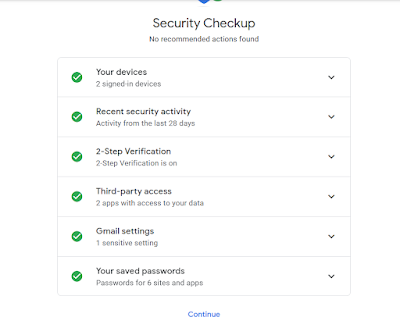

 I have a back-up phone and email for identity verification. I have the Google Authenticator on my phone (which was never used in the process). I have only given two apps direct access to my Google account. One is Dropbox, the other is one that I use to post to my blogs from my phone. Google didn't flag either as a security risk.

What happened? On Thursday night at dinner, I realized I couldn't see my mail. As I checked, I  realized that I had a problem. By 11pm, I was back home and I stopped working from my phone and went to my computer. 

My computer has dual factor authentication on it to just open it.  So it opens an app on my phone to verify my identity just to use it.  I only use work computers these days and this system is set up and maintained by corporate IT. Those are the only two devices that I have used in the last months (actually, there are two computers, both with dual factor authentication) to access my Google account in the last year.


The Google recovery process involved an easily findable page which asked me for my password, then reported it has been changed, then asked me for the most recent password that I remember. 


It then kept asking me for a phone number to verify my identity. I would get the text, enter it, and it would say that Google needs to verify the account which will take 48 hours. Forty eight hours! In the modern world, that is a long time to not be operational! What if I was on a trip? Google would also have a note that if you were in a hurry and on a device and browser that I had logged in from recently, I could accelerate it by trying again. So I would try multiple times since Google seems to suggest that repetition would help. After a few tries, I would find that it would lock me out saying to many attempts. IMHO, Google should modify their wording there so that people try the optimal number of times.  I would try to many times urged on my the if you are in a hurry message, then wait six hours and repeat.  

I had setup one recovery phone number and two recovery emails. One email, Google didn't list as an option and wouldn't seem to use when I entered it as a way to verify my identity so it did not help. The other email was on file but it was actually an email alias from a domain and email address that I own that was set up to forward to my Gmail account so it was not easily used in this situation where I had lost access to the Gmail account. This was the a mistake that I feel that I made. I should have had easier to use recovery emails.

After half a day, I figured out how to login to the web email service associated with my domain and reset it so that it stopped forwarding   emails to a Gmail account that I couldn't get it.  It has been set to forward and delete. I turned that off and now I could login with webmail to use my account. I couldn't see the emails from the previous few days which would have helped me to look for security problems. This is another step that I will take.  The reason it took me a day to get into this is that the info on where my domain is hosted and how to login to it is kept in my....Google docs! So I couldn't get to the info that way.  I had to look it up through another backup system of info that I maintain. I will revisit this too.

Root Cause Analysis. So this morning I got in, reviewed all the emails that went into my account looking for damage and malfeasance. And I'm writing this summary, considering all my different steps and precautions and my plans going foward. 


I checked the Google security info inside my account and I found that the password change was done by my phone. My iPhone  has a six digital security code on it and facial ID, was in my possession at all times.  So who did what?  Google reported two apps that had access to my Google account and it did not flag either as sketchy. One is Dropbox. The other is a great app for posting on this and other blogs when I'm mobile. I'm thinking it could have been the problem so I removed its access and will not give it my Google account login going forward. I might create a special blogger editor account for it so it will only have access to help me with the blogs.  

Now back to my claim that nobody seemed to care and that maybe, Google doesn't care. True? Overstated? Wrong Question?

Has Google already processed the event taking inventory of all my account info noting that there was a security problem and that an unwanted changed password happened on an iPhone with two apps that have access?  Does Google already know about all the other apps on my iPhone checking to see if there is a pattern of issues of apps on phones and security?

These questions are important ones and Google, secretive and mute, gives no clue as to how seriously they consider this sort of problem. The sum total of the communications from them to me after this serious and terrifying experience was an email about a new password and that congratulations, your account was recovered.

Now that I'm back inside my Google account, I have found one path towards some potential human help.

It turns out that I can get to a 2-3 minute attention from a "Google Expert".


When I do, I will ask them about what they think actually caused the changed email. There, I will use the number of the one app that had access and see what they think. Or is it another app on the phone which did not have access but somehow picked it off and used it to change it?

The weird thing that I'm trying to understand is whether, once I was hacked, did I have access to these account features to help me with recovery? Is it possible that this sort of help is only available through the account which of course, I couldn't get into and so I could not access?  I'll ask them about this too. If the service was available to me, I wonder why I never found it? Human error and lack of thoroughness by me?

It seems like by being a paying member, I am a Google One customer and we have some sort of access to help.  I've now at the top of the queue to chat (it was about 15 minutes long) and my expectations have been set to have a 2-3 minute.  My chat started 8 minutes ago with me saying:

I have now recovered control of my account and am looking for root cause of the stolen password.
My Google account reports that my password was changed (not by me) from my phone which has always been in my possession. So how did it happen? I had given access to "*****" to my Google ID on my phone. Could ****  have been the problem? Or is there another way that an app on my iPhone might have changed my password? The whole incident has been documented here:

https://www.blorum.info/2022/01/google-for-consumers-2022.html

Since then, 18 minutes of silence from them. Not even a murmur to assure me that it's still a live chat. I think I'll check with: "Are you there?"


Heh Google, really crappy chat. What gives? Do you give a damn or not? Now I"m PO'd.

I received a few days later, a Google survey asking how satisfied I am with their support efforts.  I said that I wasn't and directed them to this blog post. They also asked if I would be willing to be contacted to provide more info, we'll see if they contact me again.

I'm still researching these questions about how it happened. Here's some articles relevant to how do hackers steal your google password.


Monday, June 14, 2021

Diversification and Asset Classes by Economic Strata

 Let me start by saying I am just writing for my own clarification. This is not advice. I'm not qualified really to handle my own investments, never mind advice anyone else. For clarity, get your advice from a professional.  This is just me noodling.

The foundation of investment strategy is diversification both within and between asset classes. It's not finding hot investments, that's gambling. Investing for non-professionals is best done (per Swanson and tons of other smart investment advisors) by picking the right diversification strategy and then some low cost well run index funds (Swanson swears by non-profit investment mutual funds but he wrote prior to the super low cost index funds)

Simple: for people with some wealth. Let's say $100,000 to $1,000,000.  The truism for these people is to balance equity and debt. If you are younger and saving long term, tilt heavily towards equities. Maybe 80%. Maybe more.  Inside the equity pool, focus on index funds.  Get a selection of obvious ones perhaps mostly the US equity market (S&P500, perhaps VOO) and a smaller percentage in global developed (EAFE: non-North America public equities) or emerging (don't have an example).  The S&P index fund probably has all the diversification you could need. If you'd like you can subdivide the sectors; Example, you can distinguish between growth investing and value investing (what index vs what index) but I'm not sure there are great index funds that make creating this distinction worthwhile. For debt, it's tricky in the modern world since T bills pay basically nothing.  And while everyone agrees that in the future, there will be an interest rate, the problem with holding T bills now is that as the interest rate reinstates itself, the value of existing T bills will shrink. So, is there any value at this point in holding debt? Why not simply a money market fund?

Complicated. People with more wealth and who want to generate enough cash to live on. Retirees. $1 - $5M in total portfolio savings including IRAs and 401Ks. This is a huge group. Boomers largely watched fixed income retirement plans disappear (in the 70s-2000) to be replaced with 401Ks and IRAs so retirement became largely self financed, not counting social security which helps but for professionals with a certain life-style, it's not nearly enough.. This means that there are tons of couples who have millions in retirement savings and are trying to figure out if they can live on that. Many would like to live off the income from these savings so that they can pass it on to their children. For these people, how should they be invested. How should these people think about diversification?

Wealthy People. A third category would be people who have enough wealth (over $5M right up to 10x that) so they can invest in some number of totally illiquid investments with a longer term perspective with higher risk/return ratios.  How should they think about diversification across asset classes on criteria such as:

-    liquid vs illiquid
-    debt vs equity
-    domestic vs international vs emerging
   real estate vs corporate
-    sectors such as agriculture, tech, etc
   growth vs value
-    income vs growth

Related points for these people are tax and estate planning.
There are some pretty good articles that I can find on the first category, a few on the second, but I can't find a single good article on this third category in terms of diversification strategy.


Small Business PR

 For many years, I invested almost nothing in PR. Then, at one point about five years ago (maybe around 2015), I thought about using PR to simplify our hiring. After that, with the pandemic, homeschooling became big news.

Local PR for Local Hiring - This worked pretty well. I made a point of speaking at the local business groups where the marketing and engineering types that we were interested in would see our name. I also personally did some PR and even local advertising to support this. We took some billboards and put some ads on NPR (our local affiliate is WLRN).  I spoke at some business promotion groups locally giving a speech up at FAU (organized by the Ten Golden Rules guy), a talk at Citrix organized by <what's the name of htat group?>, and so on (I never spoke at SFIMA nor at ??? the directo marketing group) etc etc. I got stories in local blogs, newsletters, Ft Lauderdale Biz News,  and Ft Lauderdale Sun Sentinel.  Plus tons of social media..

Pandemic Time: Homeschooling is Big News: By April 2020, we had decided that we could contribute to the national discussions and hired a PR firm. We hired and I started doing press. Generally, I pushed for focusing on using moms local to the news story which everyone agreed with as more engaging and convincing.  I tried to remain in reserve to use when they wanted a business talking head. Generally, the campaign seemed successful with three big caveats.

  1. Me as a talking head spokesperson. While I'm comfortable with a live audience as a speaker, I'm awkward with a camera and a soundbite. Despite good training by the PR team, I seem to have a crooked smile, a shifty gaze (glancing at my script or notes), and to be long-winded.  I'm working on it. In response to a request for a few minute speech, I just developed a new recording style in which I simply write myself a list of points. And each point is a separate take (entrepreneur talk on 5 points). This solves the "speech" problem but doesn't address interviews. I wish I had thought of it when I got to give the Time4Learning Graduation Celebration speech (my part starts at minute 36).
  2. National Press. We've only succeed with the regional stories and had a paid insert in USA today and a huge run with one AP Press story. But mostly, we've gotten coverage in regional press especially in South Florida. If our goal is press for SEO purposes, this is pretty good.
  3. Impact? While the agency makes a good point of routinely documenting that hundreds of thousands or millions of people are exposed to these stories and our name, I've seen no evidence that it helps our business in terms of name recognition, stimulating follow-up by potential customers, or selling customers.  We recently cut a sponsorship of a TV program (The Cat in the Hat Knows a Lot About That) since while the numbers of people who saw our initial 20 second blip was huge, it seemed to have no measurable impact anywhere after six months.  While the PR effort for exposure is cheaper in terms of total monthly cash, it's also a ton more work. One added bonus however has been very useful work and thinking from the PR firm where thy function also as a marketing agency helping with message refinement and projects.
    1. Anecdotally. I never hear from anyone that they have seen our stuff. I know people everywhere so this seems weird. Especially since I know tons of people in SoFlo.  Is old media just dead?
    2. None of our marketing tracking tools have shown any surges related to where the stories ran.
    3. Our SEO team has not shown that the additional links and citations have been picked up, recognized, or counted by the search engines.
    4. Even in social media, while I see mentions by our team, they have never seemed to have any real momentum and get large numbers of links or shares. Is there a way to spin these stories to our audience which might encourage them to share the story. Many parents talk about other family members or community's skepticism about their homeschooling direction, could we write and share a link to these stories in a way that would get shared?
  4. The PR effort is very much a traditionally media focus. Except for a podcast (which had a tiny audience), it's focused on TV, radio, and newspapers. It's not designed to get big coverage from online websites or social media. Does PR of that sort exist?  Or does that really just mean doing paid work with influencers. We use to work with bloggers very effectively, both large and small. Recently, I haven't seen any real focus or success on it.

Thursday, June 10, 2021

The Comfort Zone and Learning

 I'm reading a book called License to Learn by Anna Switzer.  It's a great interesting book that blends personal experience with academic thinking and the learning sciences with some psychology. Pretty ambitious, illuminating, and engaging.

  To be honest, the first chapters annoyed me at their simplicity and the way that illustrative graphics were being used.  My complaints:

- the image of a comfort zone surrounded by a discomfort zone and then a panic zone seemed overly simplistic (I'm using different terms that were probably used in the book).
- I imagined that rather than a series of concentric circles, the concepts behind comfort zones should be shown on the initial graphic such as an X axis that maps high to low familiarity with the situation. And perhaps a Y axis that goes from no expectations to high performance, or significance or something. In this map, the lower left quadrant would be the high comfort zone.

 BUT, as I got to the next chapters (and they are short several page chapters), the analysis and imagery grew more sophisticated and addressed many of the issues that I was having with the opening.  As an editorial suggestion, I would have liked a note early on that this model will become more sophisticated in the upcoming chapters.  

Overall, I like the book. Even if I tend to think about graphics being more analytical and illustrative of underlying dynamics.

 I tend to think of these sorts of questions in light of some of the work that I do. For instance, in math education, a huge fork in the road starts with the math facts. Some kids really dig in and memorize the math facts effectively. They become fluent and proficient. This gives them enormous confidence as they go forward with math.  Many other kids do not become fluent which leads them to often have trouble following the conversation around math.

Look, we have three cars each with four wheels. These wheels each cost $200.  How much would it cost to buy new wheels? So, three cars times four wheels par car means that we have 12 wheels. The 12 wheels would cost twenty four hundred dollars.  

For kids fluent with math facts, this is pretty easy to follow. The kids lacking proficiency were unable to follow where the 12 wheels came from. These kids are the ones who put their head down on the desk in frustration and tune out.  

Of course, there are many reasons that kids do or don't become fluent. And of course, Mazlo before Lazlo is a powerful vision of what is realistic in planning a better educational system. YET, the data around the approach of Reflex Math defies that logic in that kids from every social economic strata seem to advance through the game-based learning program towards fluency at the same pace. Somehow, the engaging games and the part of the brain used for math resists the usual logic that kids' performance will generally correlate with socio economic strata. This is of course a very peculiar type of learning which could, perhaps be less affected by ACE type trauma?

For homeschoolers or study at home, Reflex is available as Time4MathFacts, with games to learn the multiplication times tables and the addition / subtraction math facts too.